
Watchlist strategy: build a balanced squad within your purse
A cricket auction strategy for team owners: plan your squad, set a max price for each target on your watchlist, and keep purse for the rest.
By Shaheem M Shereef · 7 November 2026 · 4 min read
Every auction has a team that buys three stars in the first half hour and then fills the rest of its squad with whoever is left. A good cricket auction strategy starts before the first bid: know the squad you want, decide what each player is worth to you, and keep enough purse to finish. The War Room's watchlist is built for exactly that.
Step 1: plan the squad before you plan the players
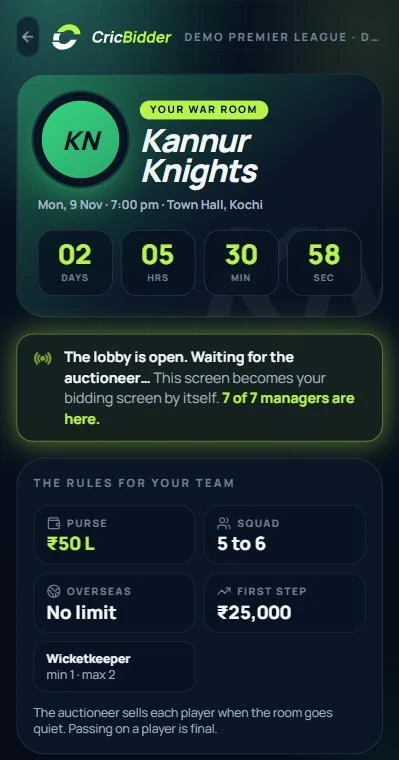
Start with your league's rules, which your War Room shows before the auction under "The rules for your team": purse, minimum and maximum squad, role limits and any overseas or guest limit. Then sketch the squad on paper:
- How many batters, bowlers, all-rounders and wicketkeepers do you need?
- Which two or three positions would you pay extra for?
- Where are you happy with a cheap, solid player?
A simple budget rule: divide the purse into a big share for your few key players and the rest spread across the squad. For example, with 10,000 points and a squad of 12, you might plan 4,500 for three key players and 5,500 for the other nine.
Step 2: build your watchlist
Scout the pool
In your War Room before the auction, open Scout the pool and search the players.
Add your targets
On each player you want, choose Add to watchlist.
Set a priority
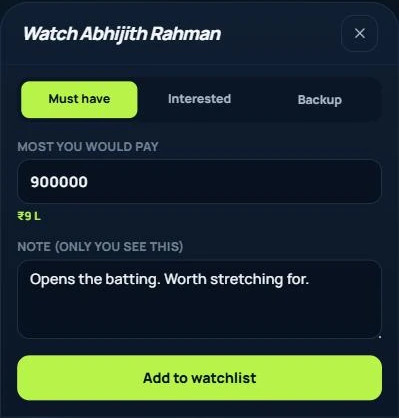
Mark them Must have, Interested or Backup.
Set a max price
In Most you would pay, enter the most that player is worth to you. Be honest: this is the number that saves you from overpaying in the heat of the moment.
Add a note
A few words only you can see, for example "opens the batting" or "only if we miss the keeper".
Step 3: use it during the auction
When a player on your watchlist comes up, your War Room shows your plan right above the price: the priority and your max. As the bidding moves, it tells you where you stand: how much room is left before your max, when the next bid goes over your max, or how far over your max the price already is.
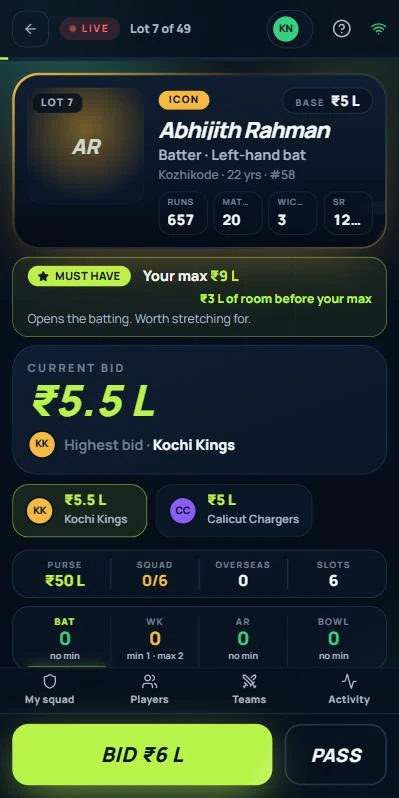
- Must have: bid with confidence up to your max. If the price passes it, stop and check your purse before going further.
- Interested: bid early while the price is low, and step out once it reaches your max.
- Backup: these are the players you buy when a must-have goes elsewhere. Keep them in mind: they are often the best value of the night.
Step 4: watch the purse, not just the player
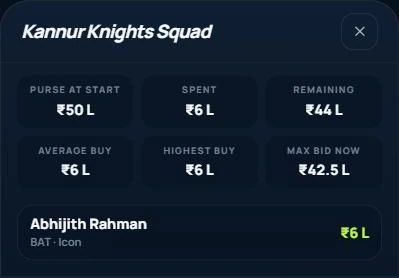
Open My squad between players. It shows your purse at the start, what is left, your highest and average buys, and Max bid now: the most you can bid right now while keeping enough to finish your squad. If Max bid now drops below the base price of the players you still need, it's time to stop chasing stars.
Common mistakes
- Spending everything early. The first sets are exciting, but many good players come up later at lower prices.
- Forgetting the role limits. If your league needs a wicketkeeper and you leave it late, you may pay too much or end up without one.
- Bidding against yourself. You can't raise your own bid. If you are already leading, wait.
- Ignoring unsold players. If your league re-auctions unsold players, often at a lower base price, there can be bargains at the end.
Can other teams see my watchlist?
No. Your watchlist, max prices and notes are only visible to you.
Does the max price stop me from bidding higher?
No. It's a guide for you, not a hard limit. The War Room warns you when the next bid goes over your max, but you can still bid if you decide the player is worth it.
Where can I practise my strategy?
Play the free auction game. You get a purse and a player pool and bid against AI teams under real auction rules, so you can try a plan before the real night.
Try a quick auction before the real one.
Shaheem M Shereef
Founder of CricBidder. Builds cricket auction software for local leagues.